

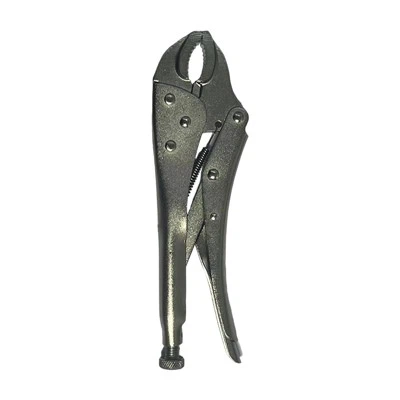
Locking pliers are a type of pliers specifically designed to hold workpieces, with the following characteristics and usage:
1, Characteristics
Automatic locking: The locking pliers can automatically adjust the clamping force according to the diameter of the workpiece, suitable for clamping parts with different diameters.
High clamping force: includes a steel locking gear mechanism that can generate higher clamping force and maintain stability under tension.
Easy to use: When in use, simply press down on the handle slightly, and the jaws can be fixed without continuous force. The locking force can be freely adjusted according to the condition of the workpiece, making it easy and flexible to use.
2, Usage method
Locking pliers are usually used to clamp workpieces by manually operating the handle. When the handle is compressed, the jaws will correspondingly close and clamp the workpiece. Due to the automatic locking function of the locking pliers, once the workpiece is clamped, the jaws will remain fixed without the need for continuous force application.
3, Application Fields
Locking pliers are widely used in multiple fields, including but not limited to:
Metal industry: Locking pliers are often used to clamp and secure metal workpieces during metal processing, assembly, and maintenance.
Automotive industry: In the manufacturing and maintenance of automobiles, locking pliers can be used to clamp various automotive components, such as engine parts, chassis components, etc.
Mechanical maintenance: In the field of mechanical maintenance, locking pliers can be used to clamp and secure mechanical components for repair or replacement.
Electronic manufacturing: In the process of electronic manufacturing, locking pliers can be used to clamp and fix circuit boards, electronic components, etc.
4, Precautions
Choose the appropriate locking pliers: Choose the appropriate locking pliers according to the size, shape, and material of the workpiece to ensure clamping effect and safety.
Correct operation: When using locking pliers, ensure that the handle is compressed correctly, the jaws are fully closed, and the workpiece is clamped. Avoid excessive force or improper operation that may cause damage to the pliers or workpiece.
Regular maintenance: Regularly check the wear of the locking pliers and replace severely worn parts in a timely manner to ensure the normal use and safety of the pliers.
In summary, locking pliers are a powerful and easy-to-use tool with wide applications in multiple fields. When using, attention should be paid to selecting appropriate pliers, correct operation, and regular maintenance to ensure its performance and safety.
Characteristics And Usage Of Locking Pliers
Send Inquiry