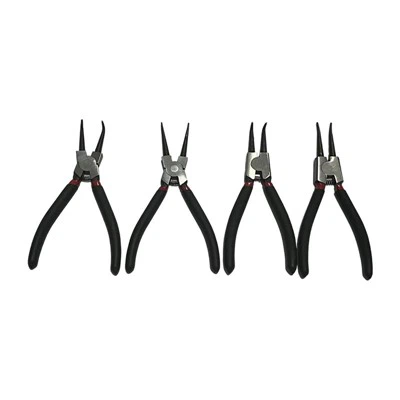
As a supplier of circlip pliers, ensuring the functionality and quality of our products is of utmost importance. Circlip pliers are specialized hand tools used for installing and removing circlips, which are small, spring-like fasteners commonly used in various mechanical applications. In this blog post, I will share the steps and methods I use to test the functionality of new circlip pliers.
1. Visual Inspection
Before conducting any functional tests, a thorough visual inspection is essential. This initial step helps identify any obvious manufacturing defects or irregularities that could affect the performance of the pliers.
- Check the Overall Structure: Examine the pliers for any signs of damage, such as cracks, bends, or misalignments in the handles, jaws, or pivot points. A well - made pair of circlip pliers should have a sturdy and symmetrical structure.
- Inspect the Jaws: The jaws of the circlip pliers are the most critical part. They should be smooth, free of burrs, and precisely machined. Any rough edges or uneven surfaces on the jaws can damage the circlips during use. Also, ensure that the jaws are properly aligned so that they can grip the circlips evenly.
- Look at the Finish: A good finish not only enhances the appearance of the pliers but also provides protection against corrosion. Check for a uniform and smooth finish on the entire surface of the pliers. Any signs of rust, peeling paint, or inconsistent coating may indicate a quality issue.
2. Handle Ergonomics
The comfort and ease of use of the pliers are crucial, especially for users who will be working with them for extended periods.
- Grip Comfort: Hold the pliers in your hand as if you were going to use them. The handles should fit comfortably in your palm, and the grip should provide sufficient traction to prevent slipping. Some circlip pliers come with rubberized or textured grips, which can significantly improve comfort and control.
- Handle Length and Leverage: The length of the handles affects the leverage provided by the pliers. Longer handles generally offer more leverage, making it easier to apply force when installing or removing circlips. Test the pliers to ensure that the handle length is appropriate for the intended applications and that you can operate them with minimal effort.
3. Jaw Opening and Closing
The ability of the jaws to open and close smoothly is a fundamental aspect of the pliers' functionality.
- Smooth Operation: Open and close the jaws of the pliers several times. They should move freely without any binding or sticking. If there is any resistance during the opening or closing process, it could be due to debris in the pivot point, misaligned parts, or improper lubrication.
- Jaw Alignment: As the jaws open and close, ensure that they remain properly aligned. Misaligned jaws can make it difficult to grip the circlips accurately and may cause damage to the circlips or the pliers themselves.
- Maximum and Minimum Opening: Check the maximum and minimum opening of the jaws. The maximum opening should be sufficient to accommodate the largest circlips you intend to work with, while the minimum opening should be small enough to grip the smallest ones securely.
4. Grip Strength
The pliers need to be able to grip the circlips firmly to perform their function effectively.
- Testing with Circlips: Use a variety of circlips of different sizes and types to test the grip strength of the pliers. Place the circlip between the jaws and apply pressure. The pliers should be able to hold the circlip securely without it slipping out.
- Even Grip Distribution: Ensure that the grip is evenly distributed across the circlip. Uneven gripping can cause the circlip to deform or break during installation or removal, which can lead to improper functioning of the mechanical components where the circlip is used.
5. Precision and Accuracy
Precision is vital when working with circlips, as they are often used in tight spaces and require accurate placement.
- Alignment with Circlip Holes: If the circlips have holes or notches for the pliers to engage with, test the pliers' ability to align with these features precisely. The jaws should fit snugly into the holes or notches, allowing for accurate handling of the circlips.
- Repeatability: Perform multiple operations with the pliers to test their repeatability. The pliers should be able to perform the same task consistently, such as opening and closing a circlip to the same degree each time. This is important for ensuring the quality and reliability of the assembly process.
6. Durability Testing
Circlip pliers need to be durable enough to withstand repeated use over time.
- Simulated Use Tests: Conduct a series of simulated use tests by repeatedly installing and removing circlips. This can help identify any issues with wear and tear, such as loosening of the pivot point, deformation of the jaws, or fatigue in the handles.
- Stress Testing: Apply a slightly higher level of force than normal during the testing to simulate extreme conditions. This can help ensure that the pliers can withstand occasional over - stress without failing. However, be careful not to damage the pliers during this process.
7. Comparison with Competitors
To provide the best products to our customers, it is also important to compare our circlip pliers with those of our competitors.
- Functionality Comparison: Compare the functionality of our pliers with similar products from other manufacturers. Look at factors such as jaw design, grip strength, and ease of use. Identify any areas where our pliers excel and areas where there may be room for improvement.
- Price - Performance Ratio: Consider the price - performance ratio of our products compared to the competition. Our goal is to offer high - quality circlip pliers at a competitive price. By comparing with competitors, we can ensure that we are providing good value for our customers.
Conclusion
Testing the functionality of new circlip pliers is a comprehensive process that involves multiple steps and considerations. By conducting thorough visual inspections, ergonomic tests, and functional tests, we can ensure that our circlip pliers meet the highest standards of quality and performance.


If you are in the market for high - quality circlip pliers or other hand tools such as Carpenters End Cutting Pliers, Slip Joint Pliers, or Germany Type Long Nose Pliers, we invite you to contact us for procurement and further discussions. We are committed to providing the best products and services to meet your needs.
References
- "Hand Tool Technology" by Smith, John. A comprehensive guide on the design and testing of hand tools.
- Industry standards and specifications for circlip pliers provided by relevant manufacturing associations.